About This Briefing
In three months, Minnesota experienced both extraordinary harm and extraordinary love.
Renée Nicole Good and Alex Jeffrey Pretti were murdered; may they both rest in peace.
During this same period, more than 4,000 people were arrested, families were separated in their own driveways, and children stopped attending school. Businesses lost over $200 million. Lawfully admitted refugees were detained under Operation PARRIS. And the announcement that Operation Metro Surge had ended was not the same as healing from the destruction it caused. Our immigrant communities are still reckoning with the fallout, and nonprofits continue to lead the response to what is, at its core, a disaster relief effort.
And yet — in those same three months — Minnesotans showed up. Tens of thousands of neighbors marched in subzero temperatures. Nearly 30,000 residents trained as constitutional observers. Nonprofits responded to cases every six minutes. And a coalition of philanthropic leaders — rooted in Latine, East African, Asian, and Native communities — chose to widen their circle and hold one another.
What they built through the Immigrant Rapid Response Fund has raised more than $13.5 million from over 65,000 donors in every state and 53 countries, deploying millions to frontline organizations from the metro to Northfield, Moorhead, St. Cloud, and communities statewide — because this crisis has never been confined to one zip code.
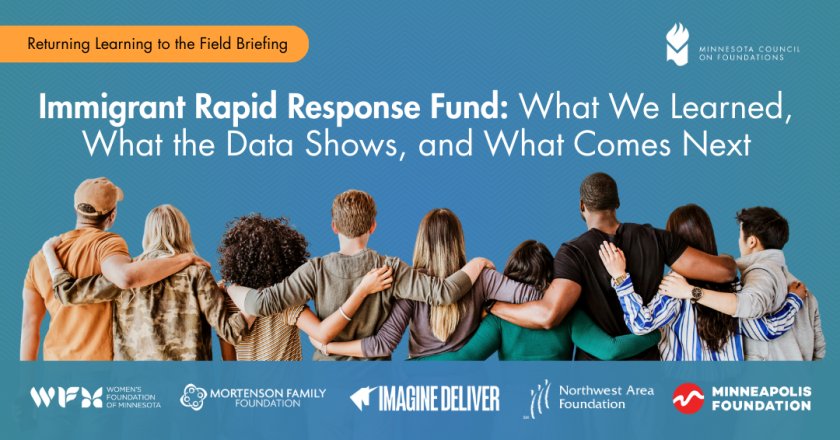
Now, we’re returning learning to the people and communities who made this possible. This briefing will share the data that guided where resources went, how funding reached communities across the state, and how the coalition maintained rigorous accountability while moving resources at the speed the crisis demanded. You’ll also hear what frontline organizations experienced on the ground and what the fund’s coalition of philanthropic and community leaders is wrestling with as it decides what comes next. Funders, nonprofits, and philanthropy-serving organizations across the country are looking to learn from Minnesota’s response — and this briefing offers an inside look at how it was built, what it took, and what it’s teaching us. The work of rebuilding — and of imagining something better — is just beginning.
What You’ll Learn
- What frontline grantees experienced and what the support meant for the communities they serve
- How IRRF used an “exposure lens” — combining baseline data with real-time community signals — to guide where resources went
- Key data on who was most affected by Operation Metro Surge, including impacts on Latine, Somali, Southeast Asian, Native, and other communities across the state
- How funding flowed across communities, regions, and support tiers — from urgent basic needs and legal defense to mobilizing and organizing
- How IRRF built rigorous due diligence and accountability into a rapid grantmaking process — moving millions in weeks while maintaining the transparency and stewardship that donors and communities deserve
- What other states and coalitions can learn from Minnesota’s model — and how this effort can inform future crisis response nationwide
- Where the fund and the broader ecosystem go from here — and how you can stay involved
Who’s Invited
Everyone. Individual donors who gave $5 or $200,000. Nonprofit staff navigating recovery and readiness. Grantees of the fund. Volunteers and constitutional observers. Faith communities and neighborhood organizations. Educators, healthcare workers, and business owners. Anyone who showed up for their neighbors — or wants to now.
Briefing Flow
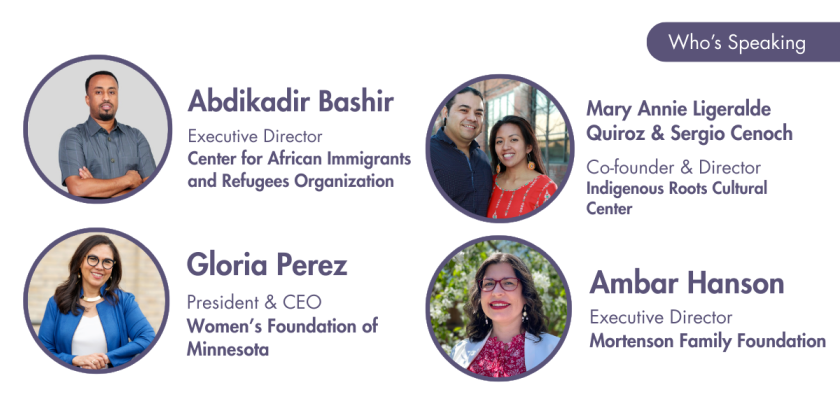
Abdikadir Bashir, Executive Director, Center for African Immigrants and Refugees Organization (CAIRE), St. Cloud
Abdikadir leads CAIRO's work across equitable education, workforce development, community health, and housing for East African immigrant and refugee communities in Central Minnesota. Under his leadership, CAIRO is developing Iskufilan Village — a 70-unit mixed-use housing and cultural hub in St. Cloud designed to address the acute shortage of right-sized housing for larger immigrant families. A PhD candidate in Organizational Leadership, Policy, and Development, Abdikadir brings over a decade of executive leadership in the social services and advocacy sector. He has navigated CAIRO through periods of rising anti-immigrant harassment in the St. Cloud region while maintaining the organization's open commitment to community-driven solutions.
Mary Anne Ligeralde Quiroz, Co-Founder and Executive Director, Indigenous Roots Cultural Arts Center
Mary Anne is an Indigenay — an Indigenous Islander Mama, dancer, artist organizer, and community activator. Born in the Philippines, she immigrated to the United States at the age of nine and grew up on the East Side of St. Paul. Together with Sergio, she co-founded Kalpulli Yaocenoxtli, a traditional Mexica Nahua dance and drum community group, in 2006, and Indigenous Roots Cultural Arts Center in 2015. What began as a dance practice has grown into a pillar of St. Paul's East Side — an incubator for BIPOC artists, a hub for cultural programming, and a launchpad for community-led organizing and solidarity work. Indigenous Roots is a recipient of the National Endowment for the Arts ArtsHERE award.
Ambar Cristina Hanson, Executive Director, Mortenson Family Foundation
Ambar leads the Foundation’s mission to build partnerships that strengthen community-driven approaches advancing equity, opportunity, and sustainable systems. Ambar earned a master’s degree in public administration from the University of Colorado, Denver, and serves on the boards of the Minnesota Council on Foundations, Latino Economic Development Center, Minnesota Public Radio and Bigelow Foundation.
Gloria Perez, President & CEO, Women’s Foundation of Minnesota
Gloria leads the nation’s first statewide women’s foundation, building pathways to prosperity for women, girls, and gender-expansive people through research, grantmaking, and policy advocacy. Previously, she became a national expert in two-generation strategies to reduce poverty as founding Executive Director and later President & CEO of Jeremiah Program, growing the organization from a local initiative to a national nonprofit. Gloria is an Ascend Fellow at the Aspen Institute and serves on several boards, including the Saint Paul & Minnesota Foundation, the Ciresi Walburn Foundation, Esperanza United and Macalester College. She earned her bachelor’s degree from Macalester College and is a recipient of an honorary doctorate from the same institution.
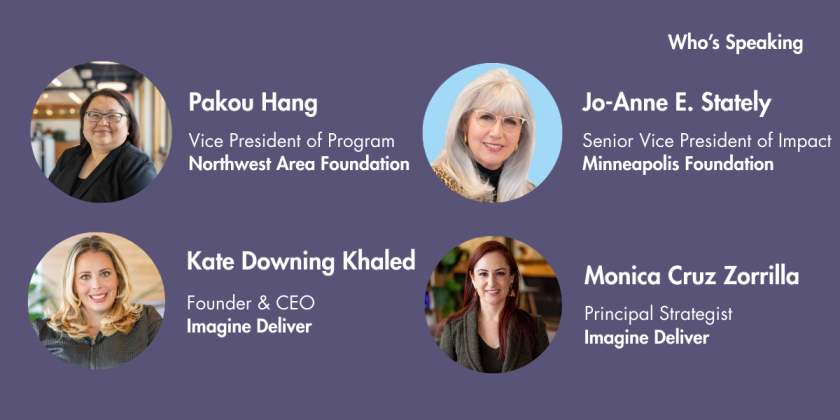
Pakou Hang, Vice President of Program, Northwest Area Foundation
Pakou leads the Foundation's grantmaking and program-related investment portfolio, guiding work toward racial, social, and economic justice across eight states and 76 Native nations. Born in a Thailand refugee camp, she immigrated to the U.S. as a political refugee at 15 days old. She is a founding member and former Executive Director of the Hmong American Farmers Association and brings the perspective of having been on both sides of the grantmaking relationship. Pakou earned a BA from Yale University and an MA in political science from the University of Minnesota.
Jo-Anne E. Stately, Senior Vice President of Impact, Minneapolis Foundation
Jo-Anne brings more than 30 years of experience in nonprofit management, public health, and philanthropy. A member of the Minneapolis Foundation's team since 2009, she oversees the Foundation's impact investing, Racial and Economic Justice grant program, and public-private partnerships including Main Street Economic Revitalization grants. Jo-Anne is a citizen of the White Earth Nation (Mississippi Band) and an enrolled member of the Minnesota Chippewa Tribe. She holds a BA in Sociology from Minnesota State University Moorhead.
Kate Downing Khaled, Founder & CEO, Imagine Deliver
Kate has nearly two decades of experience in philanthropy, community-based research, and human-centered design. She pioneered the User as Designer® and Coalition Action Model™ methodology. Under her leadership, Imagine Deliver has partnered with organizations including Ford Foundation, the Minneapolis Foundation, the McKnight Foundation, the City of Saint Paul, and the State of Minnesota.
Monica Cruz Zorrilla, Principal Strategist, Imagine Deliver
Monica develops and implements data-driven strategies that connect community insights to client goals across philanthropy, financial services, government, and large-scale initiatives. With over 18 years of experience, she has worked as a management consultant, diplomat, program manager, and researcher. She led the development of the IRRF's exposure analysis and data framework. Monica is a Hispanics in Philanthropy Líderes Fellow (2021) and a TCB Notable Hispanic Leader (2024).
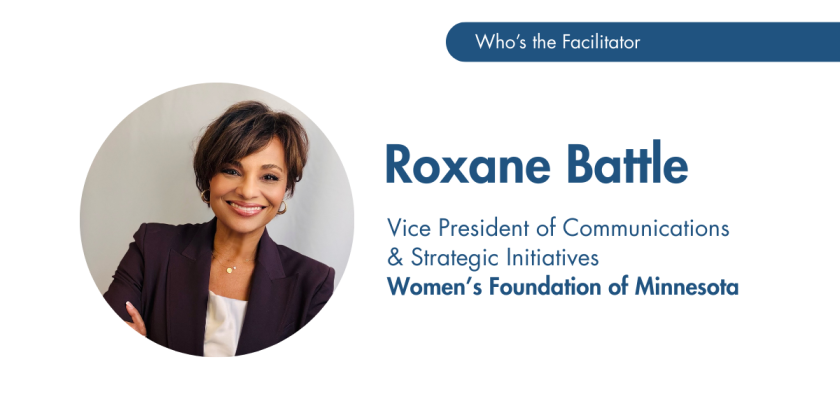
Roxane Battle, Vice President of Communications & Strategic Initiatives, Women’s Foundation of Minnesota
Roxane brings over 25 years of experience as an award-winning journalist and strategic communicator, most notably as a Twin Cities television personality on NBC-Minneapolis, KARE-11, WCCO-TV, and FOX9. Before joining the Women's Foundation in 2025, she held executive-level positions as a mental health and health equity advocate at UnitedHealth Group and served as a fundraising program producer and host for Girl Scouts River Valleys. Roxane is a best-selling author, a four-time international Telly Award winner, and a University of Minnesota-Twin Cities alumna.
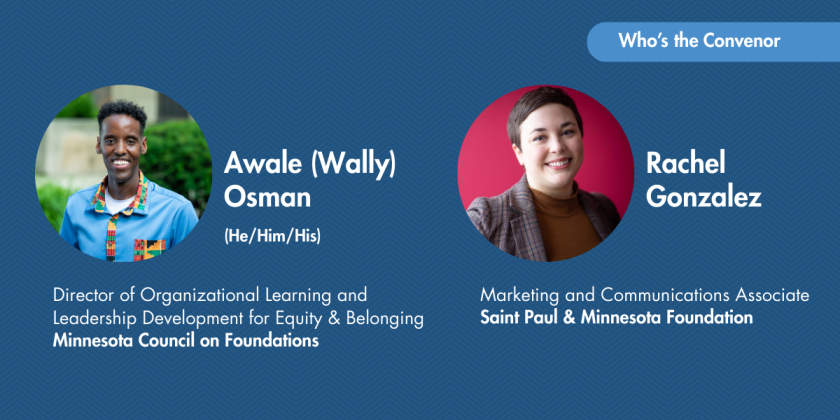
Awale (Wally) Osman, Director of Organizational Learning and Leadership Development for Equity and Belonging, Minnesota Council on Foundations
Wally leads the Minnesota Council on Foundations’ strategies for advancing internal equity, belonging, diversity, and inclusion (EBDI), as well as efforts to support the philanthropic sector in putting these values into practice through the Equity, Belonging, Diversity and Inclusion Institute (EBDI Institute). The EBDI Institute offerings include the Experiential Leadership Lab, Center for Organizational Learning and Practice, Rural Urban Bridging for Impact, People of Color and LGBTQ+ Community of Practice, learning and evaluation.
Rachel Gonzalez, Marketing and Communications Associate, Saint Paul & Minnesota Foundation
Rachel supports communications and content development for the IRRF briefing series. She brings expertise in storytelling and community-facing communications, with a background in museum education and exhibit development at institutions including the Science Museum of Minnesota and the Field Museum. Rachel holds a BA in Anthropology from Loyola University Chicago and an MSc in Museum Studies from the University of Glasgow.
Questions or Accessibility Needs? Connect with Wally!
Email Wally at [email protected].
Log-in details will be provided in your confirmation email.
Need help registering for an event? MCF's Registration FAQ page provides answers to all questions related to event registration.
MCF connects members through peer and issue networks. Learn more by visiting the peer and issue networks area of our website.
Whether you are a current member or a prospective member, Cary Walski, MCF's Member Engagement Manager, is looking forward to connecting with you.