
This legislative session, the Minnesota Council on Foundations (MCF) focused on policies that support a strong charitable sector and its ability to partner effectively with the state, as well as broader civic infrastructure and community resilience priorities. In collaboration with partners, MCF played a key role in advocating for the following legislative accomplishments:
- Creation of a standardized RFP executive summary template across all state grantmaking opportunities. Under this policy, all state agencies are required to include key information about grant opportunities at the beginning of RFPs in a standardized, easy-to-understand format — improving efficiency, clarity, and processes for both nonprofits and state agencies.
- Development and distribution of a Legislative Decision Tree tool for all state legislators. This tool supports legislative decision-making by helping determine when competitive grants versus direct appropriations are most appropriate, while encouraging consideration of factors such as conflicts of interest, readiness, and other key criteria.
- Successful opposition to an overly broad proposed ban on direct appropriations to nonprofits and foundations. Such a ban would have weakened the sector’s ability to partner efficiently with the state during crises and likely would have disproportionately harmed small, rural, and culturally-specific nonprofits
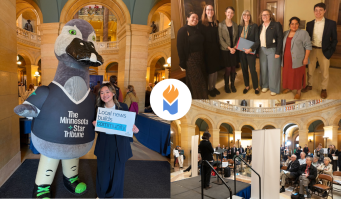
- Partnership between Press Forward Minnesota (housed at MCF) and True North News Alliance to support the first-ever rally calling on lawmakers to invest in local news as essential civic infrastructure.
MCF also advocated for several key priorities that were not passed this session, including:
- $100 million in small business relief for businesses impacted by Operation Metro Surge, emphasizing the importance of state funding alongside philanthropic and other local resources
- Ability for the sector to partner with the state’s green bank (MNCIFA) through grants and loans
- Additional support for emergency management staffing statewide to ensure every county and Tribal nation has at least one full-time emergency manager
MCF is also monitoring broader outcomes related to state grant processes, oversight, and program integrity. This includes recently passed laws that establish an Office of Inspector General; expand state agency authority to withhold payments in cases of suspected fraud; require the development of a grantee fraud risk rating system tied to grants management requirements; and fund IT modernization efforts.
In addition, MCF and its state grant reform partners are actively engaging with the Office of Grants Management — which sets policies and practices for grantmaking across all state agencies — to incorporate sector perspectives as policies are updated and new laws are implemented.
Finally, MCF is monitoring a constitutional amendment that will appear on the 2026 ballot to increase school funding by raising the Permanent School Fund endowment payout rate to 4.5%. This amendment has the potential to spark broader public awareness and conversation about how endowments function and how they can provide long-term, sustainable support to communities.
Learn more about MCF's Public Policy work and Advocacy Agenda.
Celebrating Patricia’s 22 Years of Service at MCF
Longtime MCF staff member Patricia Starks-Faggett is embarking on a new adventure — retirement!
New Report: Documenting Philanthropy’s Response to Operation Metro Surge
MCF's Rapid Response report documents how Minnesota’s philanthropic sector mobilized more than $70.5 million in aid, and reflects on the information coordination efforts in the wake of Operation Metro Surge.
MCF’s Member Experience Survey Reveals Strong Member Satisfaction
MCF's bi-annual Member Experience Survey provides valuable insight into what's working, what's needed, and what's possible for the future of membership.