
Session Overview
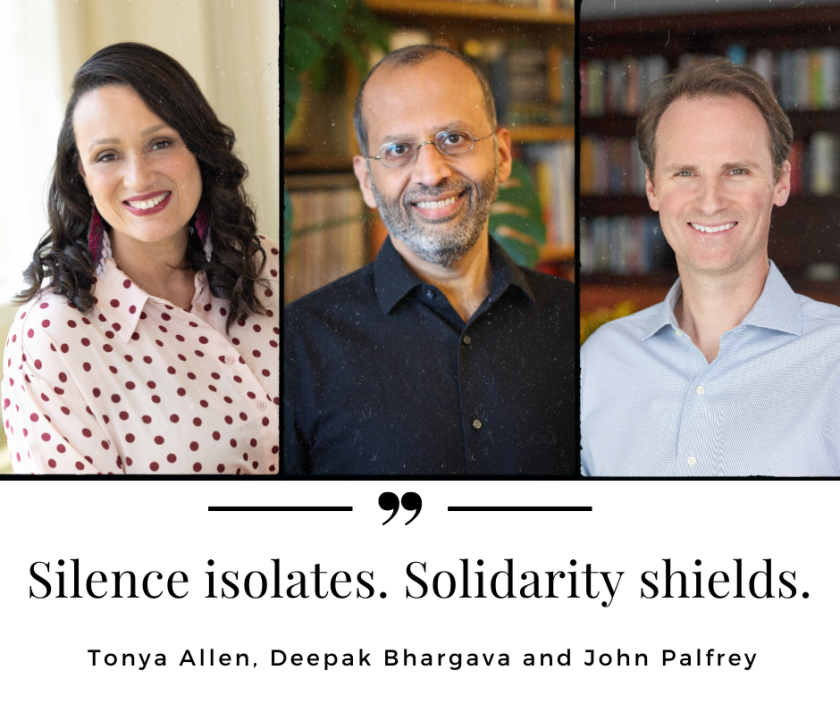
These powerful words from Tonya Allen, Deepak Bhargava and John Palfrey capture the essence of our challenge and opportunity in philanthropy today: retreat into silence or lean into solidarity. While caution is understandable, evidence and experience suggest speaking up isn’t just courageous—it’s perhaps an opportunity and responsibility for effective philanthropy, especially now.
Why This Matters Now
Philanthropy as a field can show up and contribute to our society in a way no other sector can. The business sector is often beholden to shareholders and profit motives, government entities are constrained by political pressures, and the education sector generally has ideological influences. Philanthropy has greater independence to respond in ways that serve the best interests of our communities as they evolve over time, creating unique leverage points that other sectors simply don't have.
This independence is needed now more than ever to help decrease the uncertainty penalty we're all experiencing, especially our nonprofit community amid new challenges against diversity, equity, and inclusion initiatives.
Minnesota Philanthropy’s Legacy & Growing National Movement
Minnesota philanthropy has a proud history of speaking up during challenging times – from our collective response after George Floyd’s murder to our united front during the COVID-19 pandemic. This track record provides a strong foundation to experiment taking action, even when outcomes are unknown. Furthermore, Attorney General Keith Ellison joined 16 attorneys general affirming the limits of federal authority over lawful private sector activities. This local legal context complements a growing national understanding, underscored by the “Unite in Advance” campaign, that philanthropy must proactively defend its independence. As the campaign highlights, philanthropy’s unique structure allows it to respond to community needs in ways other sectors can’t, making that independence crucial, especially when nonprofits face threats related to funding or diversity, equity and inclusion work.
Recent research from the Center for Effective Philanthropy shows that 77% of nonprofit leaders want more communication about the significant difficulties for their vital work. During Foundations on the Hill meetings, nonprofit partners stated plainly: “We need to hear from philanthropy more often, even when you're still figuring things out.”
Foundation leaders across Minnesota and the country are responding with their voice:
- McKnight Foundation: “Despite recent events, actions, and executive orders, we remain steadfast in advancing climate solutions and racial equity across every part of our work... We actively resist the inaccurate coopting of diversity, equity, and inclusion language.”
- Bush Foundation: “We still believe that our approach to equity is squarely aligned with our purpose, is within the law, and makes us better at what we do.”
- Duluth Superior Area Community Foundation: “Equity is at the heart of our work, not as a political stance, but as a fundamental belief in fairness, opportunity, and belonging.”
- Saint Paul & Minnesota Foundation: “In times of uncertainty, we remain committed to our values of community-first leadership, belonging, and equity—not as political positions, but as essential principles for creating a Minnesota where all communities can thrive.”
- Robert Wood Johnson Foundation: “We will keep speaking in the media, online, behind closed doors, and any place we are invited. The barriers to generational health for all communities are not going away. Therefore, neither can our willingness to speak up.”
These statements demonstrate that foundations can speak with clarity and conviction while maintaining their unique voices. Beyond grant dollars, we have enormous power in philanthropy with the questions we ask and the issues we raise.
Intended Session Objectives
This session creates conditions for:
- Exploring and learning from the spectrum of ways foundations can use their voice ( individually, institutionally and collectively)
- Practice becoming aware and using yourself as a learning territory in developing messaging that aligns with your philanthropic and leadership values
- Learn from real examples using your voice publicly
- Develop approaches for regular, open communication with grantees
- Understand the legal context that supports continued DEI work in philanthropy
Pre-Session Reflection Questions
- How does your foundation currently use its voice beyond grantmaking? Where does your organization fall on the spectrum from quiet funder to public advocate?
- What concerns or hesitations do you have about speaking more publicly on Diversity, Equity and Inclusion values?
- What messages from your foundation would be most valuable to your grantees right now?
- How do your foundation’s mission and values inform when and how you should speak publicly?
- Which aspects of the foundation statements you’ve read (McKnight, Bush, Duluth Superior, RWJF, etc.) resonate most with your organization’s approach and voice?
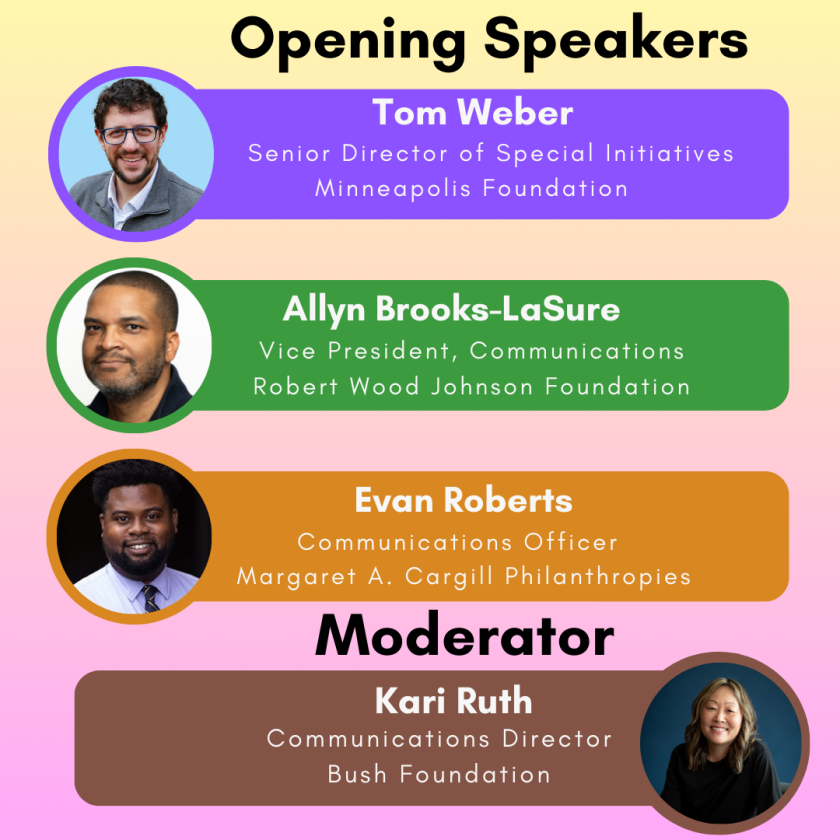
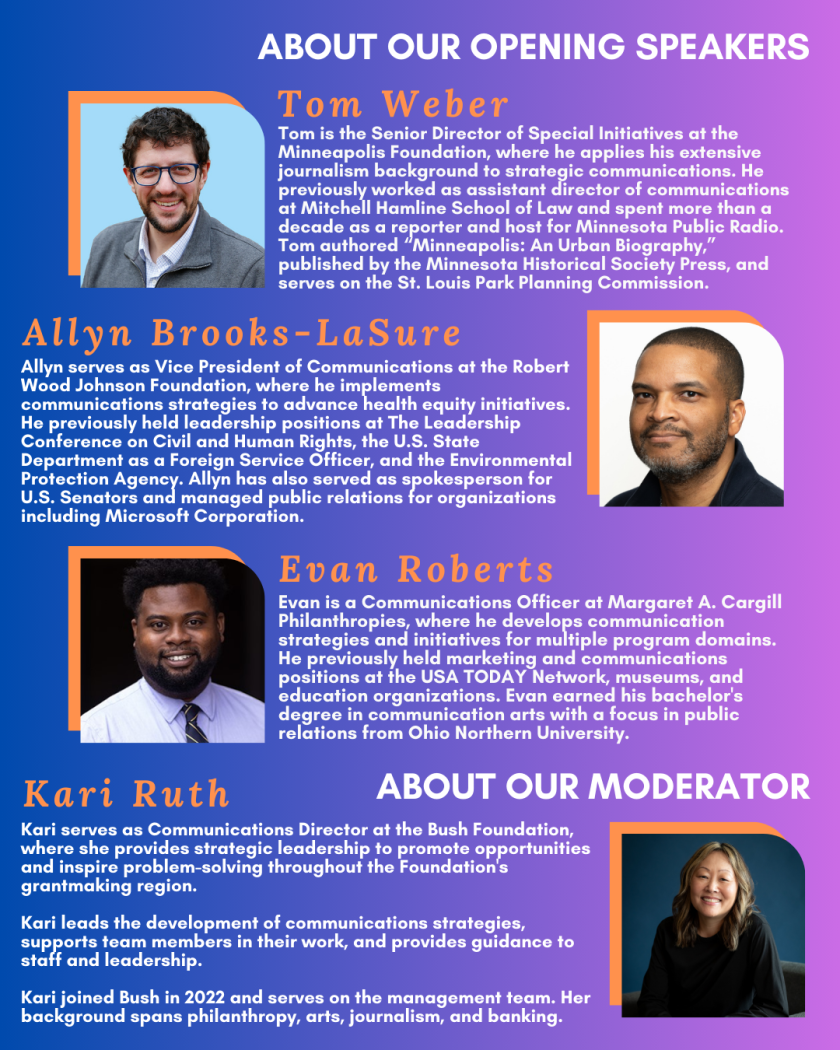
We’re grateful to have Tom Weber, Allyn Brooks-LaSure, Evan Roberts and Kari Ruth help set the context for our collective exchange of experiences and help to lower the barriers to speaking publicly - individually, institutionally and collectively.
Summary Runsheet
Time | Session content |
10m | Settle In and Program Introduction Centering activity and introduction to program flow. |
45m | Fish Bowl Opening conversation with Tom, Allyn, Evan and Kari. |
20m | Collective Sense-making Together make sense of the session theme and share helpful resources with each other. |
30m | Ubuntu Circle Drawing from the African philosophy of ubuntu—meaning ‘I am because we are’—this practice increases the likelihood for clarity, commitment and new possibilities for action to emerge . The Ubuntu Circle honors multiple ways of knowing and reminds us that our growth as leaders is fundamentally connected to our relationships and community. |
15m | Debrief & Close What was your experience? What kinds of things do you see now? Take aways? What will you try? Reminders and where we’re going next. |
Optional Pre-Reads
- Unite in Advance: Philanthropy Coalition Launches Solidarity Campaign by Tonya Allen, Deepak Bhargava and John Palfrey
- It’s Time for a New Approach to the Current Context by Phil Buchanan
- Chaos, Cruelty, and Coercion: How Philanthropy Can Respond by Kevin Bolduc
- Joint statement from Minnesota state attorney general and 12 others
Logistics
● Zoom link provided upon registration
● In-session materials and resources shared afterward
Questions or Accessibility Needs?
Please contact Awale (Wally) Osman at [email protected] with any questions about the program or registration process.
Need help registering for an event? MCF's Registration FAQ page provides answers to all questions related to event registration.
MCF connects members through peer and issue networks. Learn more by visiting the peer and issue networks area of our website.
Whether you are a current member or a prospective member, Cary Walski, MCF's Member Engagement Manager, is looking forward to connecting with you.