
Bridging the Gap: Grantee Perspectives on Intermediary Funders

Intermediary funders have been the subject of increased support and attention in recent years. According to The Bridgespan Group, a nonprofit consulting firm, the number of organizations that can serve as intermediaries has increased substantially over the past 15 years. Intermediary grantmaking institutions have been established and funded — often with support from foundations — for a number of reasons, including but not limited to their proximity to communities, efficiency, expertise, and ability to facilitate collaboration across donors. The structures of these intermediaries are also varied, ranging from nonprofits that act as regrantors to donor collaboratives with pooled funds. The increased attention on intermediaries has sparked further discussion about why funders choose to use them.

Most research on intermediaries over the past decade has used data collected from either intermediaries themselves or originating funders seeking this kind of partnership, while relatively little is known about the experience of those funded by intermediary organizations. Using data from the past 10 years of our Grantee Perception Report (GPR), a comparative grantee survey used by hundreds of funders, the Center for Effective Philanthropy (CEP) aimed to learn more about the experiences of grantees that receive support from intermediary funders.

Download the report

Share This
More ResourcesSee All Resources
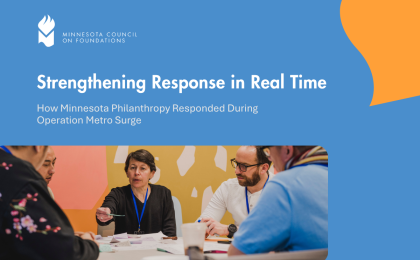
Strengthening Response in Real Time

This Rapid Response Report serves as a testimony to how Minnesota’s philanthropic ecosystem organized during a critical moment in state history. It offers vital lessons, structural insights, and

Placeholder image

Guide to Fiscal Sponsorship

As fiscal sponsorship continues to become a more widely used tool for charitable impact, it is important that 501(c)(3) organizations acting as a fiscal sponsor are doing it right.

Placeholder image

Immigrant Rapid Response Fund: Briefing Series

Between Christmas 2025 and February 2026, Operation Metro Surge brought roughly 2,000 federal immigration agents to the Twin Cities. More than 4,000 people were arrested. Two Minnesotans were killed.

X